3D Modelling and Visualisation in Portugal
4D Virtual Lab creates 3D models and visualisations in Portugal from real objects, buildings and sites. We capture them with 3D scanning, laser scanning and LiDAR. Then we turn the data into models, digital twins, virtual tours and AR or VR experiences. We work across Portugal and Spain from São João da Madeira. Call 916 552 931 for a budget.
What does 3D modelling and visualisation include?
3D modelling is building an accurate digital copy of a real object or space. Visualisation is how that copy is shown to people. It can be an image, a video, a tour they walk through, or a model that appears in front of them. We do both, starting from the real thing rather than from a sketch. A sculpture, a machine part, a room or a whole building can be scanned and then modelled. The finished model can be measured, studied, printed, placed in a presentation or shown to visitors online. Our work covers 3D scanning and digitisation, laser scanning and LiDAR surveying, 3D modelling and visualisation, and digital twin creation. It also covers 3D virtual tours, AR and VR experiences, holographic displays, and photography and video. With over 20 years of experience, our aim is to turn physical spaces, objects and heritage into accurate and engaging digital experiences. Start with our 3D scanning services to see how the data is captured.
Where does the data for a 3D model come from?
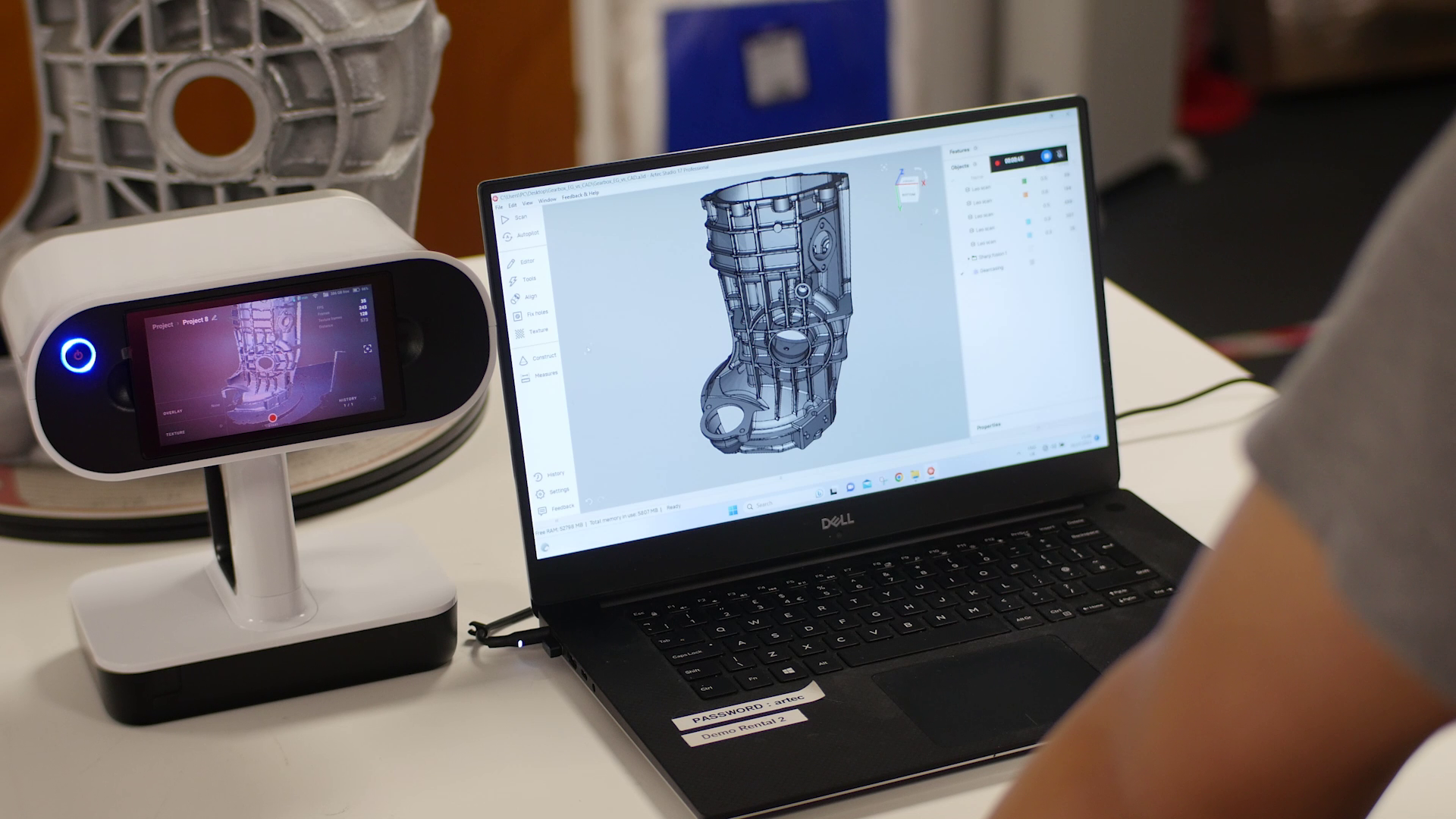
Most of our models start with a scan of the real object or space. For objects, we use handheld 3D scanners. Many use structured light (a pattern of light projected onto the surface, which the scanner reads to measure its shape). For rooms, buildings and land, we use laser scanning and LiDAR (light detection and ranging, a laser that measures distance). These produce a point cloud (millions of measured points that make up a 3D picture). We then clean the scan data and build the model. For engineers and architects, the model can be turned into CAD files (computer-aided design drawings used for design and manufacture). That is the basis of our reverse engineering work and of our surveys for architecture. Because we start from a scan, the model shows the object as it really is today. Wear and later changes are included.
Who uses 3D modelling and visualisation?
The sectors we serve are medical, architecture, industrial, museums, cultural institutions, scientific and archaeology. Each uses the same models in a different way. An architect may need an accurate model of a historic building before planning work on it. A factory may need a model of a worn part so it can be made again. A museum may want visitors to explore a collection online, or see an object in AR on their phone. A scientist may want to measure and compare specimens without handling them. A hospital or medical school may want anatomical models for teaching. Our focus is scientific and cultural work. We serve clients mainly in Portugal and Spain, in Portuguese and English. If your project sits outside these fields, call us anyway. The scanning and modelling steps are the same, and the first meeting will show whether we are the right fit.
What can you do with the finished model?
The same 3D model can be delivered in several forms, depending on who needs to see it and where. The table shows the outputs we produce and what each one is used for.
| Output | What it is used for |
|---|---|
| 3D model or CAD file | Design, measurement, inspection and reverse engineering |
| Digital twin | An accurate virtual copy of a building or site for planning and monitoring |
| 3D virtual tour | Visitors explore a space online, with text, photos, audio and video |
| AR and VR experience | Models shown over the real world or all around the viewer |
| Holographic display | An object shown in 3D inside a display case at an event or museum |
| Photography and video | Marketing, exhibitions and records of the work |
See our 3D virtual tours, AR and VR experiences and holographic displays for each output in more depth.
How does a project run, and what does it cost?
Each project runs in four steps: meeting, budget, execution and delivery. At the meeting we look at the object or space, who will use the model and the formats you need. We then send a written budget for that scope. The price depends on the size and detail of what we capture and where we scan it. The number of outputs you want also counts. A single model costs less than a model plus a tour and an AR experience. Travel within Portugal and Spain is part of the budget. Once you agree, we scan, model and visualise, then deliver the files and any tour or display. If your team would rather scan in-house, we sell scanners too, such as the 3DeVOK MT Gen 2 at €7,400 before VAT. Call 916 552 931, Monday to Friday, 9:00 to 18:00, or send your details through our contact form.
Why work with a 3D studio based in Portugal?
A local studio can visit your site, meet you in person and work in Portuguese. Our Portuguese office is at the Oliva Creative Factory in São João da Madeira, and our company there is 4D Virtual Lab Portugal, LDA. We serve clients across Portugal and Spain. Our headquarters are at 17 Princess Road, London NW1 8JR, which helps on projects with English-speaking partners. 4D Virtual Lab dates from 2021, and its five collaborators bring more than 20 years of experience in culture and heritage. Tiago Queiroz is a partner in the business. We work in Portuguese and English, so a tour or a presentation can serve local and international audiences. For a museum or university, that means one studio can scan, model and present the result in both languages. For an industrial client, it means a scan and a model from a team that is a short drive away rather than abroad.
Why build a 3D model from a scan instead of from drawings?
Drawings show how something was designed; a scan shows how it is today. For a historic building, the original plans are often missing or no longer match after decades of changes. For a worn machine part, the drawing may not exist at all. For a sculpture, there never was one.
Starting from a scan means the model matches the real object, including wear, distortion and later repairs, so decisions made on screen hold up on site or in the workshop.
Which choices set the scope of a modelling project?
Two choices shape most modelling projects: how much detail the model needs, and how many ways it will be shown.
| Choice | Simpler scope | Larger scope |
|---|---|---|
| Level of detail | Shape and proportions for a presentation | Measurement-grade geometry for CAD, inspection or restoration |
| Surface | Geometry only | Full colour and texture |
| Outputs | One model file | Model plus digital twin, virtual tour, AR or VR, or holographic display |
| Subject | A single object | A whole building or site |
Settling these early keeps the budget clear and avoids rework later.
Questions about 3D modelling
What formats can the model be exported in?
We agree the formats at the first meeting, so the files open in the software your team already uses.
Can I put the virtual tour on my website?
Yes. A tour can be shared by link or embedded in your own website.
Can you make an English version?
Yes. We work in Portuguese and English, so tours and text can be produced in both.
Do you work outside Portugal?
Yes. We cover Portugal and Spain, and our headquarters are in London.
The team at 4D Virtual Lab