Scientific 3D Visualisation in Portugal
4D Virtual Lab produces scientific 3D visualisation for universities, laboratories, museums and research teams in Portugal and Spain. We scan specimens, equipment, rooms and sites, then present the data as 3D models, point clouds, virtual tours, AR and VR, or holographic displays. Call 916 552 931 to talk about your project.
What is scientific 3D visualisation?
Scientific 3D visualisation is showing real scientific objects and data in three dimensions, so they can be measured, explored and explained. It starts with accurate capture. A specimen, an instrument, a laboratory or a field site is scanned first. The scan becomes a 3D model or a point cloud (millions of measured points that make up a 3D picture). The model can then be rotated, sectioned, compared and shared. For a researcher, that means measuring a specimen without handling it again. For a teacher, it means showing a whole class the same object from every angle. For a museum, it means opening a collection to people who cannot visit. Scientific clients are one of the sectors we serve, and we describe our focus as scientific and cultural. With over 20 years of experience, our aim is to preserve, explore and communicate the world around us through digital tools. Our 3D scanning services show the first step in more detail.
What can be scanned and visualised?
Most physical subjects in science can be captured, from small specimens to whole sites. The method depends on size. The table shows how we usually work.
| Subject | How we capture it | Typical output |
|---|---|---|
| Specimens and small objects | Handheld 3D scanner | Textured 3D model |
| Instruments and equipment | Handheld 3D scanner | 3D model or CAD file |
| Laboratories and buildings | Laser scanning and LiDAR | Point cloud, digital twin, virtual tour |
| Field sites and terrain | LiDAR, ground laser scanners and drones | Point cloud and terrain model |
Handheld scanners often use structured light (a projected light pattern the scanner reads to measure the surface). LiDAR (light detection and ranging) uses a laser to measure distance. Neither needs to touch the subject, which suits fragile or valuable material.
How does 3D visualisation help research and teaching?
3D visualisation lets people study and explain things they cannot easily hold, reach or see. A specimen that is too fragile to pass around can be studied on any screen. Measurements can be taken from the model and repeated later, because the model does not change. Two scans made at different times can be compared to show change, which supports monitoring of sites and collections. In teaching, a model turns a flat diagram into an object students can rotate and explore. A digital twin (an accurate virtual copy of a real place) lets students walk a laboratory or a field site before they go there. Large point clouds can be viewed and worked on with specialist software. Veesus point cloud software is one option for very large scan datasets. Because the same data serves research and teaching, one capture can be used for many years and many purposes.
How do we present the results?
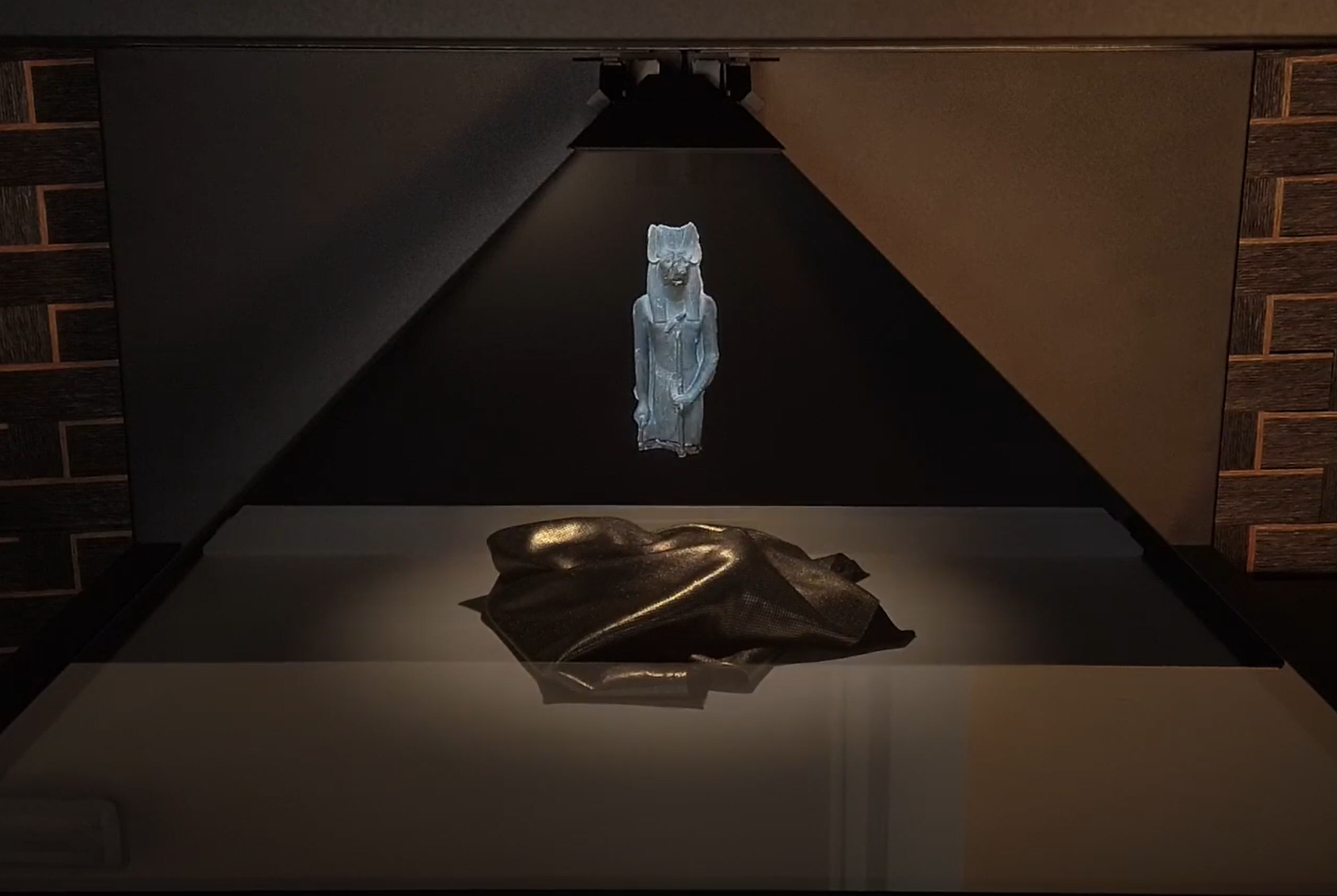
We present scientific models in the format that suits the audience: screen, headset, display case or web page. A 3D virtual tour lets people move through a laboratory, museum or site online, with text, photographs, audio and video at points of interest. It can be shared by link or embedded in your own website. Augmented reality (AR) shows a digital object over the real world. Virtual reality (VR) places the viewer inside a digital space. Both bring models into lessons and exhibitions. A holographic display shows an object in 3D inside a display case, which works well at events and in galleries. Our media production team adds photography and video. See our holographic displays, our AR and VR experiences and our 3D virtual tours. We work in Portuguese and English, so the same result can serve local and international audiences.
How does a project run, and what does it cost?
Each project runs in four steps: meeting, budget, execution and delivery. At the meeting we look at your subjects, the questions you want the data to answer and who will see the result. We then send a written budget for that scope. The price depends on how many subjects there are and how large and detailed they are. Where we scan also counts, as does the choice between a model only or a model with a tour, AR or a display. Once the budget is agreed, we capture, process and present the data, then deliver the files. We work across Portugal and Spain from the Oliva Creative Factory in São João da Madeira. Call 916 552 931, Monday to Friday, 9:00 to 18:00, or use our contact form.
Who will work on your project?
4D Virtual Lab is a specialist company with five collaborators and more than 20 years of experience in scientific and cultural work. The company dates from 2021. Our headquarters are at 17 Princess Road, London NW1 8JR. Our twin company, 4D Virtual Lab Portugal, LDA, works from São João da Madeira. Tiago Queiroz is a partner in the business. We aim to be reliable and expert, and we keep one contact with you from the first meeting to delivery. We offer every service behind scientific visualisation. That covers 3D scanning, LiDAR surveying, 3D modelling, digital twins, AR and VR, holographic displays and media production. That means the scan, the model and the way it is presented are planned together from the start. For larger sites and terrain, our 3D surveying covers the ground work.
Can the data be reused in papers and future research?
Yes, and it is worth planning for from the start. Agreeing widely supported file formats at the first meeting, keeping the scan data alongside the processed models, and preparing lighter versions for web and teaching means one capture can support a paper, a lecture and an exhibition.
Because a 3D record does not change, measurements can be repeated by other researchers later, which helps when results need to be checked or compared.
How does the research question shape the capture?
The right capture method depends less on the equipment than on what the data needs to answer.
| Your goal | What the capture plans for |
|---|---|
| Measure or compare specimens | High resolution and consistent capture settings across every subject |
| Monitor a site or collection over time | Repeatable survey positions and a baseline record for later comparison |
| Teach or explain | Lighter, textured models for screens, AR and VR |
| Reach the public | A virtual tour or holographic display |
Questions about scientific 3D visualisation
Does scanning touch the specimen?
No. 3D scanners and LiDAR measure with light, so the subject is only handled as much as moving it requires.
What formats can the data be exported in?
We agree the formats at the first meeting, so the files open in the software your group already uses.
Can we track how many people view the tour?
Yes. Virtual tours can report viewing statistics, so you can see how the tour is used.
Can you make an English version?
Yes. We work in Portuguese and English, so text and tours can be produced in both.
The team at 4D Virtual Lab