What Materials Can Be 3D Scanned? A Practical Guide
Most solid materials can be 3D scanned, including stone, wood, plastic, ceramics, plaster, bone, fabric and painted or matte metal. Shiny, transparent, very dark or moving surfaces are harder for optical scanners, but they can often still be captured with the right scanner, technique or a light surface preparation.
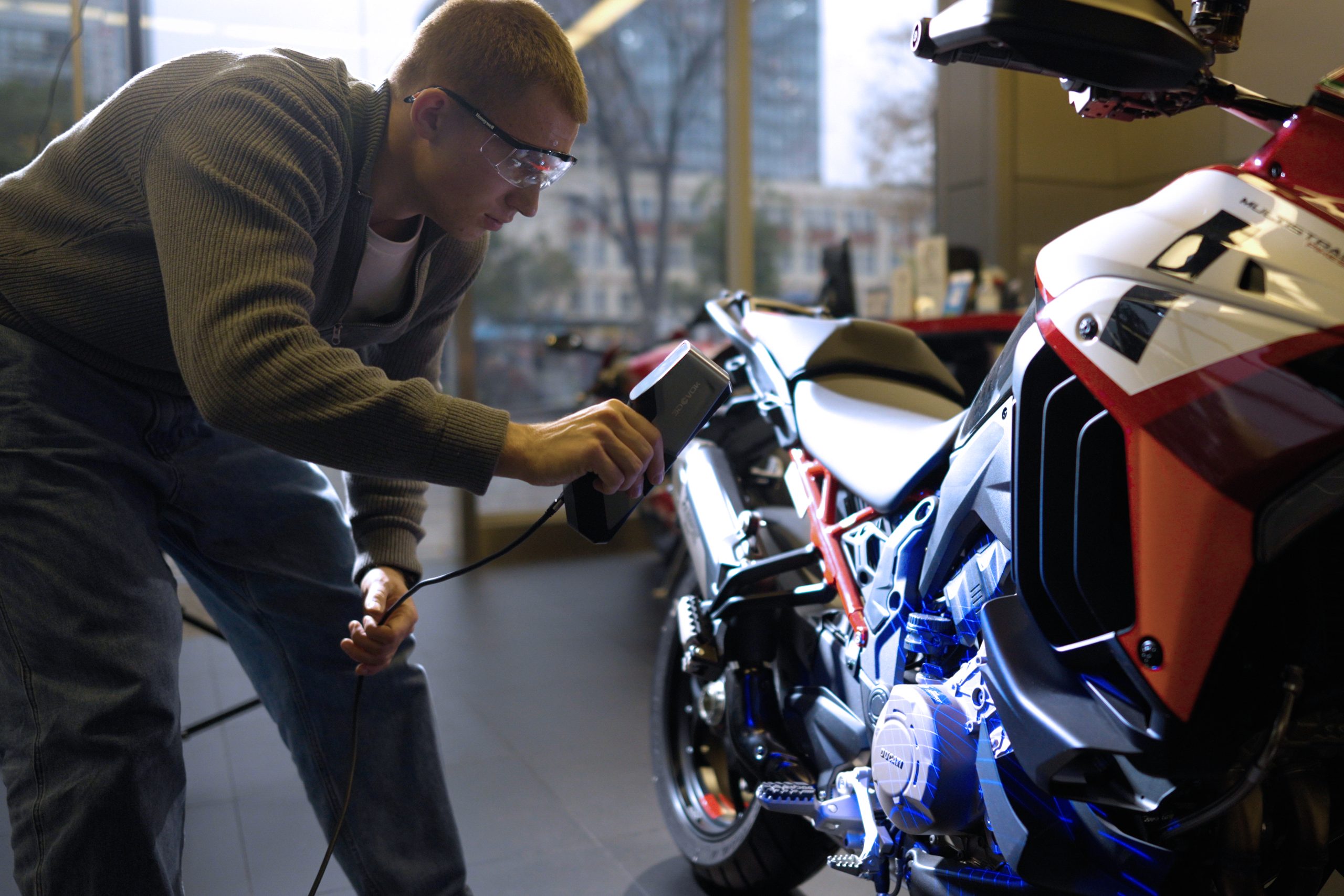
How does a 3D scanner “see” a material?
It is one of the first questions we hear from museums, manufacturers, researchers and architects: will my object actually scan? The short answer is that the material matters less than how its surface behaves under light. This guide explains which materials scan easily, which need extra care, and how 4D Virtual Lab approaches each case.
The handheld scanners we use for objects, such as the Artec 3D structured light scanners, project a pattern of light onto the surface and use cameras to measure how that pattern bends over the shape. Laser scanners and LiDAR, which we use for buildings and outdoor sites, measure light that is reflected back to the instrument. In both cases the scanner needs the surface to return light in a predictable way.
That is why surface finish is the deciding factor. A matte, light-coloured surface scatters light evenly and gives the cameras a clean signal. A mirror-like, glass-clear or very black surface either bounces the light away, lets it pass through, or absorbs it, and the scanner receives little or confusing data.
Which materials are easiest to 3D scan?
Materials with a matte, non-reflective, opaque surface are the most straightforward. Typical examples include:
- Stone, marble and plaster – sculptures, architectural elements, carved details and casts.
- Wood – furniture, carvings, frames and historic joinery.
- Ceramics and terracotta (unglazed or low-gloss) – pottery, tiles and archaeological fragments.
- Bone and fossils – common in archaeology, natural history and scientific collections.
- Plastics and resins with a matte finish – product parts, prototypes and housings.
- Painted, cast or machined metal without a polished finish – mechanical parts, tools and components.
- Textiles, leather and paper – clothing, hats, books and other objects, provided they stay still during the scan.
- The human body – parts of the body can be scanned for medical and prosthetic work, as long as the person keeps still.
Which materials are difficult to 3D scan, and why?
| Material or surface | Why it is difficult | What usually helps |
|---|---|---|
| Shiny or polished metal, chrome, gloss paint | Reflections send the light away or create false highlights | A scanner designed for reflective surfaces, adjusted settings, or a thin removable scanning spray |
| Glass, clear plastic, liquids | Light passes through instead of reflecting from the surface | A temporary coating, or capturing the shape a different way |
| Very dark or black surfaces | The surface absorbs much of the projected light | Changing exposure and scanner settings, more passes, or a light coating where allowed |
| Hair, fur, feathers, very fine fibres | Detail is finer than the scanner can resolve and edges are soft | Expect a simplified surface, or combine with photography |
| Very small or highly detailed objects | Fine features need a high-resolution scanner and careful handling | A high-resolution scanner suited to small objects |
| Soft, flexible or moving objects | The shape changes between scan passes | Supporting the object, scanning quickly, or keeping the subject still |
Can shiny metal and reflective parts be 3D scanned?
Yes, in many cases. Reflective metal is one of the most common challenges in reverse engineering and quality inspection, and scanner manufacturers have worked hard on it. The 3DeVOK Mt scanner, which 4D Virtual Lab supplies in Portugal as authorised master reseller, is described by its maker as performing well on metallic and reflective surfaces, which makes it suited to industrial parts.
Where a surface is too reflective for direct scanning, a thin layer of scanning spray is sometimes applied to give it a temporary matte finish. This is a common, well-established technique, but it is only used when it is suitable for the object and the client agrees to it.
Can transparent materials such as glass be scanned?
Clear glass and transparent plastic are among the hardest materials for any optical scanner, because the light passes straight through. A temporary coating is the usual solution for industrial parts. For delicate or valuable glass, the right approach depends on what you need the 3D model for, so it is worth talking it through before deciding.
Is it safe to scan fragile museum objects and artworks?
Structured light scanning is a non-contact method: the scanner never touches the surface. The Artec scanners we use also do not require the “targets” (stickers) that many other professional scanners rely on, which can damage works and objects. That is why this technology is widely used for restoration and preservation, from sculptures and artefacts to architectural details.
With heritage objects, we do not apply sprays or coatings without the agreement of the conservator responsible for the piece. If a surface cannot be prepared, we work with what the scanner can capture and explain any limitations before the work starts.
What about large spaces, buildings and outdoor sites?
For buildings, interiors and landscapes we use ground laser scanners, LiDAR and drones rather than handheld scanners. These capture brick, stone, concrete, render, timber and terrain well. Large windows, mirrors, water and polished floors can still produce gaps or reflections in the data, so we plan the scanning positions around them.
How do we check whether your material can be scanned?
Every project follows the same simple process:
- Meeting – you tell us about the object or space, its materials and what you need the 3D model for.
- Budget – we recommend the scanning method and any preparation, and send a quote.
- Execution – we carry out the scan.
- Delivery – you receive the digital model and data.
If you are unsure about a material, send us a photo and a short description. Call us on 916 552 931 (Monday to Friday, 9:00-18:00) or send us a message through our contact page. We work across Portugal and Spain from Oliva Creative Factory in São João da Madeira.
Frequently asked questions
Can any material be 3D scanned?
Most solid, opaque materials can be scanned. Shiny, transparent, very dark, very fine or moving surfaces are harder, but many can still be captured with the right scanner or a light surface preparation.
Do you always use scanning spray on difficult surfaces?
No. Spray is only used when the surface needs it, when it is suitable for the object and when you agree. On heritage objects it is never used without the conservator’s approval.
Can you scan people or parts of the body?
Yes. Structured light scanners are used in medicine for work such as prosthetics and custom implants. The person simply needs to stay still while the scan is taken.
Can you scan metal parts for reverse engineering?
Yes. Metal parts are commonly scanned for reverse engineering, quality inspection and replacing legacy parts. Polished or chrome finishes may need a scanner suited to reflective surfaces or a temporary matte coating.
Can I buy a scanner instead of using your scanning service?
Yes. 4D Virtual Lab sells Artec 3D scanners and is the authorised master reseller of 3DeVOK scanners in Portugal, with training and technical support.
Reviewed by Tiago Queiroz, Partner, 4D Virtual Lab.